✨ This article was AI edited. Editorial responsibility: ScoreGuitar.com.
Drop C tuning is one of the most powerful, versatile, and aggressive alternate guitar tunings in modern rock, heavy metal, post-hardcore, and alternative music. By lowering your entire instrument one full step below standard and dropping the 6th string an additional whole step, Drop C delivers crushing low-end punch, cavernous resonance, and lightning-fast single-finger power chord playability.
Whether you are setting up your electric guitar for Drop C for the first time or looking to master drop-tuned chords and intonation, this comprehensive guide covers everything you need to know.
What is Drop C Tuning? (Notes, Strings, and Frequencies)
In standard guitar tuning, the strings are tuned to E-A-D-G-B-E. In Drop C, every string is detuned down by two semitones (one full tone), except the lowest 6th string, which is lowered by four semitones (two full tones) from standard E down to low C:
| String Number | Standard Tuning Note | Drop C Tuning Note | Exact Pitch Frequency (Hz) | Interval Relative to Standard |
|---|---|---|---|---|
| 6th String (Lowest) | E2 (82.41 Hz) | C2 | 65.41 Hz | Down 4 semitones (2 whole steps) |
| 5th String | A2 (110.00 Hz) | G2 | 98.00 Hz | Down 2 semitones (1 whole step) |
| 4th String | D3 (146.83 Hz) | C3 | 130.81 Hz | Down 2 semitones (1 whole step) |
| 3rd String | G3 (196.00 Hz) | F3 | 174.61 Hz | Down 2 semitones (1 whole step) |
| 2nd String | B3 (246.94 Hz) | A3 | 220.00 Hz | Down 2 semitones (1 whole step) |
| 1st String (Highest) | E4 (329.63 Hz) | D4 | 293.66 Hz | Down 2 semitones (1 whole step) |
The resulting string sequence from lowest to highest pitch is: C – G – C – F – A – D.
How to Tune to Drop C: Step-by-Step Instructions
Method 1: Using a Chromatic Electronic Tuner (Recommended)
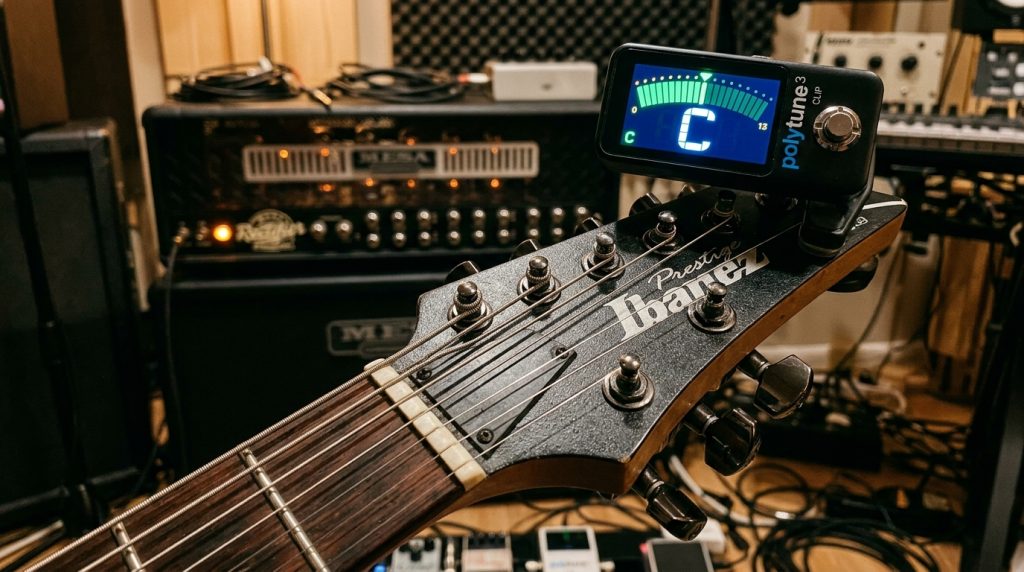
- Plug your guitar into a precision chromatic tuner or attach a digital clip-on tuner to the headstock.
- Tune String 1 (High E): Pluck the 1st string and loosen the tuning peg until the tuner reads D (D4).
- Tune String 2 (B): Detune the 2nd string down one whole step to A (A3).
- Tune String 3 (G): Detune the 3rd string down one whole step to F (F3).
- Tune String 4 (D): Detune the 4th string down one whole step to C (C3).
- Tune String 5 (A): Detune the 5th string down one whole step to G (G2).
- Tune String 6 (Low E): Detune the 6th string down two whole steps to C (C2).
- Double Check All Strings: Detuning reduces overall neck tension, which relaxes the neck and alters string pitch. Repeat the tuning cycle 2–3 times until all strings stabilize at pitch.
Method 2: Tuning by Ear from Standard Tuning
- First tune your entire guitar down one full step to D Standard (D-G-C-F-A-D).
- Play your open 4th string (now tuned to C3).
- Pluck the 6th string and detune it downward until the pitch harmonizes an exact octave below the 4th string (or play the 7th fret harmonic of the 6th string, matching the open 5th string G).
Optimal String Gauges for Drop C Tuning
Standard light strings (such as .009–.042 or .010–.046) become excessively loose, floppy, and prone to severe fret buzz when detuned down to Drop C. To maintain balanced string tension and tight low-end definition, select a dedicated heavy-gauge string set:
| Scale Length | Recommended Gauge | Tension Feel | Best For |
|---|---|---|---|
| 24.75″ (Gibson Scale) | .011 – .056 (or .012 – .060) | Firm, tight low C, clear string articulation | Heavy metal riffing, crushing rhythms, drop chords |
| 25.5″ (Fender / Ibanez Scale) | .010 – .052 (Light Top / Heavy Bottom) | Balanced, easy bending on high strings, punchy low C | Modern metalcore, soloing, mixed rhythm & lead |
| 25.5″ (Heavy Riffing) | .011 – .054 (Beefy Slinky / D’Addario EXL117) | Very tight low end, prevents intonation drift | Aggressive chugging, fast downpicking riffs |
Guitar Setup Adjustments for Drop C
Transitioning a guitar permanently or semi-permanently to Drop C requires four essential setup checks:
- Truss Rod Relief: Heavier strings combined with lower pitch alter total longitudinal neck tension. Check your 7th fret relief and adjust the truss rod if backbow or excessive upbow occurs.
- Nut Slot Width: A thicker .054 or .056 low C string may bind in a factory nut slotted for a .042 string. Gently widening the 6th string nut slot prevents string binding and tuning instability.
- Bridge Saddle Intonation: Because thicker lower-frequency strings require more physical length compensation, adjust your 6th string saddle backward away from the neck until the 12th fret fretted note matches the 12th fret harmonic.
- Action Height: Set the low C string height to approximately 1.8mm – 2.2mm at the 12th fret to accommodate the wider vibrational ellipse of the low C string without fret rattle.
Essential Drop C Chords and One-Finger Power Chords
The greatest structural advantage of Drop C is that the bottom three strings (C – G – C) form a root-fifth-octave power chord (C5) when played completely open. You can bar any single fret across the lowest three strings with one finger to play instant power chords:
- Open (0-0-0-x-x-x): C5 Power Chord
- 2nd Fret (2-2-2-x-x-x): D5 Power Chord
- 3rd Fret (3-3-3-x-x-x): D#5 / Eb5 Power Chord
- 5th Fret (5-5-5-x-x-x): F5 Power Chord
- 7th Fret (7-7-7-x-x-x): G5 Power Chord
- 8th Fret (8-8-8-x-x-x): G#5 / Ab5 Power Chord
- 10th Fret (10-10-10-x-x-x): A#5 / Bb5 Power Chord
- 12th Fret (12-12-12-x-x-x): C5 (Octave) Power Chord
Famous Songs in Drop C Tuning
If you want great songs to practice in Drop C, explore these legendary tracks:
- System of a Down: “Toxicity”, “Chop Suey!”, “Aerials”
- Deftones: “My Own Summer (Shove It)”, “Change (In the House of Flies)”
- Bullet for My Valentine: “Tears Don’t Fall”, “Your Betrayal”
- Killswitch Engage: “My Curse”, “The End of Heartache”
- Slipknot: “My Plague” (Drop C variations)
- Rammstein: “Mein Herz Brennt”
- Mastodon: “Blood and Thunder” (Drop A / Drop C hybrid)
Frequently Asked Questions (FAQ)
Can I play Drop C on a standard acoustic guitar?
Yes, but you will need medium-to-heavy acoustic guitar strings (such as .013–.056 gauge). Standard light acoustic strings will feel excessively loose and may buzz loudly against the frets.
Is Drop C the same as D Standard?
No. In D Standard, every string is tuned down one whole step (D-G-C-F-A-D). In Drop C, the lowest string is dropped an additional whole step to C (C-G-C-F-A-D), enabling one-finger barre power chords.
Will tuning to Drop C damage my guitar neck?
No. Tuning down reduces overall tension, which is completely safe for your instrument. Using appropriate heavier string gauges restores healthy tension equilibrium across the fretboard.