✨ This article was AI edited. Editorial responsibility: ScoreGuitar.com.
A bent guitar neck is one of the most frustrating obstacles a guitarist can encounter. Whether you are experiencing severe fret buzz on the lower frets, an impossibly high action that makes playing above the 7th fret agonizing, or uneven pitch intonation across the fretboard, a warped or bent neck directly compromises your instrument’s playability and tone.
Understanding Guitar Neck Warping and Bending
Guitar necks are subjected to constant physical tension. A standard set of acoustic guitar strings (such as .012–.053 light gauge) exerts between 150 and 180 pounds of continuous pulling force against the headstock. For electric guitars, tension typically ranges between 100 and 140 pounds. The internal steel truss rod is designed to counterbalance this continuous mechanical load.
When environmental conditions fluctuate or string gauges change without proper calibration, the delicate equilibrium between string pull and truss rod counter-tension is disrupted. Let us explore the primary types of neck bending:
| Neck Condition | Physical Geometry | Common Symptoms | Primary Cause |
|---|---|---|---|
| Upbow (Forward Bow) | Center of neck dips away from strings (concave curve) | Excessively high action in the middle registers (frets 5–12), stiff string feel | Insufficient truss rod tension, heavier string gauge, high humidity |
| Backbow (Reverse Bow) | Center of neck arches upward toward strings (convex curve) | Severe fret buzzing on open strings and frets 1–5, choking notes | Over-tightened truss rod, drop in ambient humidity, lighter strings |
| Twisted Neck | Bass side and treble side have unequal curvature or rotation | Fret buzz exclusively on bass or treble side, impossible intonation | Asymmetrical grain shrinkage, uneven moisture loss, structural defect |
| Neck Hump (Ski Jump) | Fretboard rises abruptly where the neck joins the body (frets 14–17) | Choked notes and buzzing above the 12th fret despite proper relief | Body expansion, neck joint settling, glue creep over decades |
How to Accurately Diagnose a Bent Guitar Neck
Before turning any adjustment tool, you must accurately measure the current state of your neck relief. Guesswork frequently leads to stripped truss rod nuts or aggravated neck bow.
Method 1: The Capo and Fret Tap Test (Field Diagnostic)
- Tune your guitar to standard concert pitch. Neck relief must always be evaluated under full string tension.
- Place a capo firmly at the 1st fret across all six strings.
- Fret the low E string with your dominant pinky or thumb at the fret where the neck meets the body (usually the 14th fret on acoustics or 16th/17th fret on electrics).
- Look closely at the gap between the bottom of the low E string and the top of the 7th or 8th fret crown.
- Tap the string gently over the 7th fret. You should hear a tiny click and see a hairline gap roughly the thickness of a business card (approximately 0.008 to 0.012 inches / 0.2 to 0.3 mm).
If the string rests firmly against the 7th fret without any clearance, the neck is in a backbow. If the gap is thick (resembling the thickness of a heavy guitar pick or coin), the neck has an excessive upbow.
Method 2: Precision Straightedge and Feeler Gauges (Bench Standard)
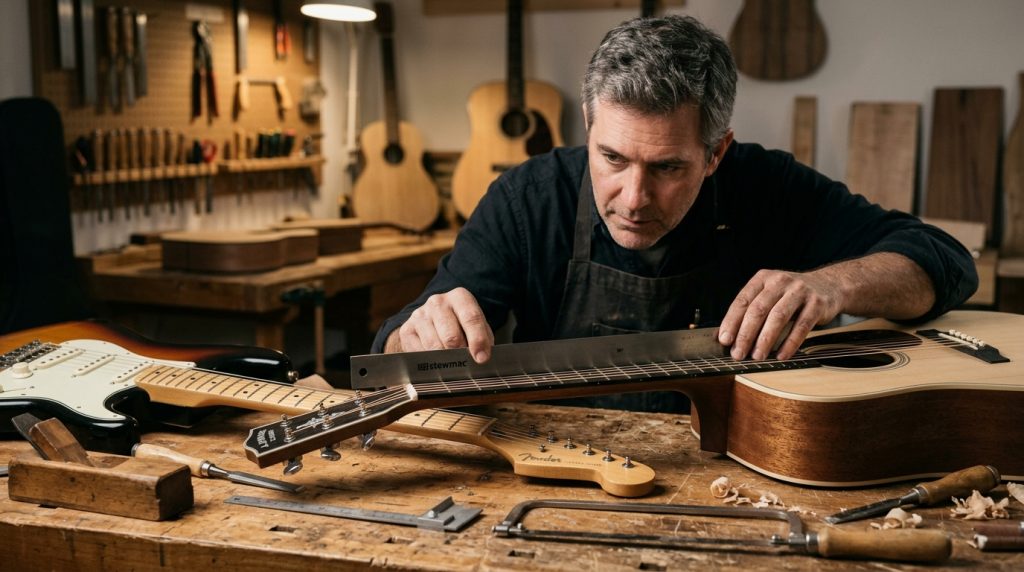
Professional luthiers use a notched straightedge that rests directly on the wooden fretboard rather than the fret tops. By inserting standard automotive feeler gauges between the straightedge and the 8th fret, you can measure relief down to thousandths of an inch:
- Electric Guitars (Modern fast action): 0.006″ to 0.010″ (0.15 mm to 0.25 mm)
- Acoustic Guitars (Dynamic strumming): 0.008″ to 0.012″ (0.20 mm to 0.30 mm)
- Bass Guitars (Large string oscillation): 0.012″ to 0.018″ (0.30 mm to 0.45 mm)
Step-by-Step Truss Rod Adjustment Protocol
The truss rod is a threaded steel rod running along the internal channel beneath the fretboard. Adjusting it alters the longitudinal curvature of the neck.
Tools Required
- Matching truss rod wrench (Hex/Allen wrench: typically 4mm, 5mm, 1/8″, 3/16″, or box-socket wrench for Gibson/Taylor).
- Capo and feeler gauge or business card.
- Electronic chromatic tuner.
Adjustment Rules (The Clockwise / Counter-Clockwise Rule)
Look directly down the headstock toward the bridge:
- To Fix an Upbow (Too high action / concave neck): Turn the truss rod nut CLOCKWISE (Tighten). This exerts backward pressure against the neck, pulling it flatter.
- To Fix a Backbow (Fret buzz / convex neck): Turn the truss rod nut COUNTER-CLOCKWISE (Loosen). This relaxes the steel tension, allowing string pull to create forward relief.
Crucial Rule of Luthier Safety: Never turn the truss rod more than 1/8 to 1/4 turn at a time. Allow the wood fibers 15 to 30 minutes to settle and equilibrate under the new tension before re-measuring.
Handling Severe Neck Warps, Twists, and Humidity Damage
When a neck suffers from a 3D structural twist or a localized warp that truss rod adjustments cannot correct, professional lutherie intervention is required:
1. Heat Pressing and Clamping
Luthiers use specialized heated neck-clamping cauls (such as StewMac neck heat irons). The neck is clamped in reverse curvature and heated to soften the fretboard glue and wood lignin, then cooled under clamp pressure to permanently reset the straight grain profile.
2. Fret Leveling, Recrowning, and Planing
If the twist is minor (under 0.015 inches), removing the frets, precision-planing the wooden fretboard radius flat on a leveling beam, and re-fretting with fresh nickel-silver or stainless steel wire produces a perfectly straight playing surface.
Preventative Storage: Protecting Your Guitar from Warping
Wood is a hygroscopic material that expands in high humidity and shrinks in dry air. Prevent bent guitar necks with these preventative practices:
- Maintain Relative Humidity (RH) between 45% and 55%: In dry winter months, use soundhole humidifiers (like D’Addario Humidipak or Oasis). In swampy summers, store instruments in cases with desiccant packs.
- Avoid Direct Heat and Cold Exposure: Never leave your guitar inside a parked vehicle in hot weather or near domestic radiators. Extreme heat softens neck joint glue (Titebond/hide glue) within hours.
- Loosen String Tension for Long-Term Storage: If storing an instrument unplayed for over 3 months, detune strings by 1 to 2 whole tones to eliminate excessive sustained longitudinal strain.
Frequently Asked Questions (FAQ)
Can a bent guitar neck be fixed at home?
Yes. Forward upbow and minor backbow are standard setup adjustments that can be resolved at home using the proper truss rod wrench in 1/8-turn increments. However, structural twists and broken truss rods should always be entrusted to a professional repair shop.
How much does it cost to fix a bent guitar neck?
A standard neck relief and truss rod setup costs between $40 and $80. Heat-pressing a warped neck typically ranges from $120 to $200, while a complete fretboard replaning and refret costs between $250 and $450.
Why does my guitar neck bend in winter?
Indoor heating dramatically reduces indoor relative humidity, often dropping below 25% RH. The fretboard and neck wood lose internal moisture, causing wood shrinkage that induces backbow and protruding sharp fret ends.